Nature knows best
Breastmilk is widely recognised as the gold standard of infant nutrition, providing a unique blend of essential nutrients including proteins, vitamins, and growth factors that naturally adapt to meet each infant’s individual needs.1 This rich composition supports the infant’s overall health and physical development besides playing a vital role in their cognitive development.1
The World Health Organization recommends exclusive breastfeeding for the first six months of life.2 After the age of six months, infants require additional energy and nutrients beyond what breastmilk alone can provide.2 At this stage, nutritionally adequate and safe complementary foods should be introduced while continuing breastfeeding up to two years of age or beyond.2
The infant nutrient gap
Infants older than six months are vulnerable to micronutrient malnutrition due to high demands for vitamins and minerals needed to support their rapid growth and development.3 Predominantly plant-based diets often fail to provide enough key micronutrients to meet their recommended intakes.4 The inclusion of animal-sourced foods can help address these gaps, but the quantities infants can realistically consume are insufficient to meet their needs for nutrients such as iron, calcium, and in some cases, zinc.4
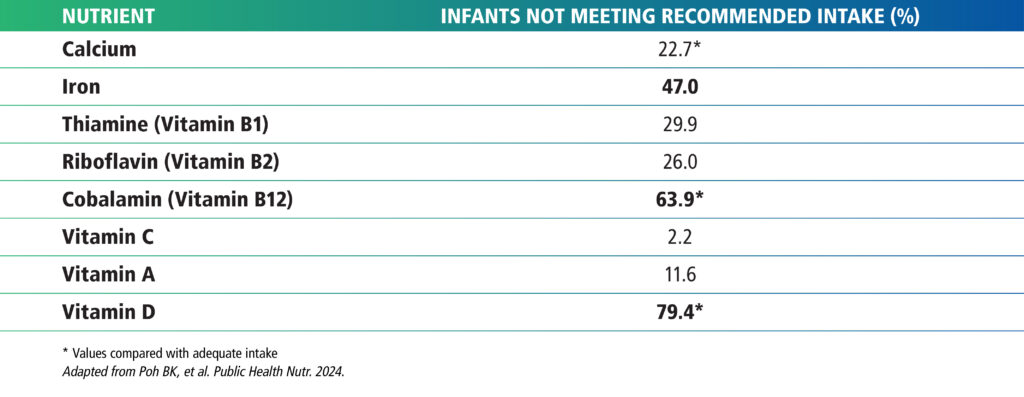
Globally, iron and vitamin A deficiencies represent a significant proportion of micronutrient malnutrition. Iron deficiency affects approximately 54% of children aged 6-59 months in Southeast Asia, while an estimated 29% of preschool-aged children in low- and middle-income countries suffer from vitamin A deficiency.3 In Malaysia, infants aged 6-11 months are estimated to have the greatest shortfalls in meeting the recommended micronutrient intake for iron, vitamin B12 and vitamin D (Table 1).5
Table 1: Percentage of infants 6-11 months not meeting the Malaysian recommended micronutrient intake
It is also common for multiple micronutrient deficiencies to occur simultaneously.3 Combined deficiencies during the critical window from preconception to 23 months of age can result in irreversible physical and cognitive impairments, impacting an infant’s quality of life and life expectancy.3
Optimising infant nutrition with food fortification
To prevent nutrient deficiencies among infants, targeted food fortification strategies can be applied to foods specifically produced for this age group.6 Food fortification is the practice of deliberately adding one or more essential micronutrients to foods to improve its nutritional quality.6 Besides preventing deficiencies, infant food fortification has the potential to improve suboptimal nutritional status and enhance overall health through benefits provided by the micronutrients.6
Complementary infant foods like formula and cereal-based products are often centrally fortified with multiple micronutrients, making it easier to adhere to the World Health Organization’s recommendation of providing infants with fortified complementary foods as needed.4,7 While there is no fixed amount or specific set of nutrients required for fortifying infant foods, national food regulations provide guidance on the appropriate fortification levels for these commercially-produced products.7 In Malaysia, approximately 81% of dry or instant cereal products for infants are adequately fortified with vitamins D, B2, and B6, while around 75% are appropriately fortified with iron, zinc, and vitamins A, B1, B3, C, and E.7
Iron is perhaps the most important nutrient to include when fortifying infant food, as iron-deficiency anaemia is the most common condition worldwide resulting from a nutritional deficiency.8 Studies have shown that infants fed iron-fortified foods have up to a 58% lower risk of anaemia, along with higher haemoglobin and serum ferritin levels, compared to infants fed unfortified foods.9 The evidence supporting infants’ additional need for iron is substantial that both the European Society for Pediatric Gastroenterology, Hepatology, and Nutrition (ESPHGAN) and the American Academy of Pediatrics (AAP) recommend iron-fortified formula for all formula-fed infants.8
Strong start for all
All in all, infant food fortification is an effective strategy to bridge nutritional gaps, especially after six months of age when breastmilk alone cannot support healthy development. This approach supports optimal nutrition in early life, helping reduce infant morbidity and mortality, while promoting better overall development.2 It also aligns with the United Nations’ commitment to ensuring every infant’s right to good nutrition.2
Looking to improve your healthcare brand presence?
At MediConnexions Consulting, we offer a wide range of integrated medical marketing and communication services. With over 10 years of experience in the industry, we help organisations develop marketing tools, documents, and scientific materials that drive results and connect with your audience. Here’s what we offer:
Medical Writing
Development of medical content for healthcare professionals and organisations.
Creative Services
Design of promotional materials, brand assets, and tailored marketing campaigns.
Copywriting
Creation of compelling content for advertisements, social media, and brain messaging.
Digital Services
Personalised digital marketing to engage your target audience efficiently.
Event Management
Planning and execution of events with seamless coordination.
Ready to take your healthcare brand presence to the next level?
Click here to get started!
References
1. Purkiewicz A, Regin KJ, Mumtaz W, Pietrzak-Fiećko R. Breastfeeding: the multifaceted impact on child development and maternal well-being. Nutrients. 2025;17(8):1326.
2. World Health Organization. Infant and young child feeding. 2023. Available at https://www.who.int/news-room/fact-sheets/detail/infant-and-young-child-feeding. Accessed on 16 March 2026.
3. World Health Organization.WHO guideline: use of multiple micronutrient powders for point-of-use fortification of foods consumed by infants and young children aged 6–23 months and children aged 2–12 years. Geneva: World Health Organization; 2016.
4. Dewey K. Guiding principles for complementary feeding of the breastfed child. Washington: Division of Health Promotion and Protection Food and Nutrition Program, Pan American Health Organization; 2003.
5. Poh BK, Wong JE, Lee ST, et al. Triple burden of malnutrition among Malaysian children aged 6 months to 12 years: current findings from SEANUTS II Malaysia. Public Health Nutr. 2024;27(1):e151.
6. Allen L, de Benoist B, Dary O, et al. Guidelines on food fortification with micronutrients. Geneva: World Health Organization; 2006.
7. White J, Blankenship J, Kupka R, et al. Consortium for Improving Complementary Foods in Southeast Asia (COMMIT). Malaysia COMMIT Synthesis Report. Bangkok: United Nations Children’s Fund; 2023.
8. Kleinman RE. Introduction: recommended iron levels for nutritional formulas for infants. J Pediatr. 2015;167(4):S1-S2.
9. Das JK, Salam RA, Kumar R, Bhutta ZA. Micronutrient fortification of food and its impact on woman and child health: a systematic review. Syst Rev. 2013;2:67.
